
Equipment performance hinges far more on consistent maintenance than the unit’s original build quality. To keep industrial energy saving air conditioners delivering reliable cooling, sustained energy efficiency and fewer breakdowns year‑round, proper routine maintenance is critical. Below is a unit maintenance checklist for operators and installers of industrial energy saving air conditioning systems to perform self‑inspections.
Why Regular Maintenance Is Essential for Industrial Air Conditioning
Factory workshops operate under harsh conditions: heavy dust, elevated ambient temperatures, and extended continuous runtime. Compared to residential air conditioners, industrial energy saving air conditioners face far more demanding operating environments. Built‑up dust, restricted heat dissipation and trapped moisture will gradually lead to multiple operational issues:
- Degraded cooling capacity and insufficient temperature control across the workshop
- Rising power consumption and increased operational costs
- Compressor overload, triggering high‑temperature cutouts and error shutdowns; accelerated component wear and shortened equipment lifespan
This is especially critical for facilities in hot, humid overseas regions and factories running non‑stop production. Scheduled maintenance preserves stable cooling performance, maintains optimal energy efficiency and reduces long‑term repair expenses.
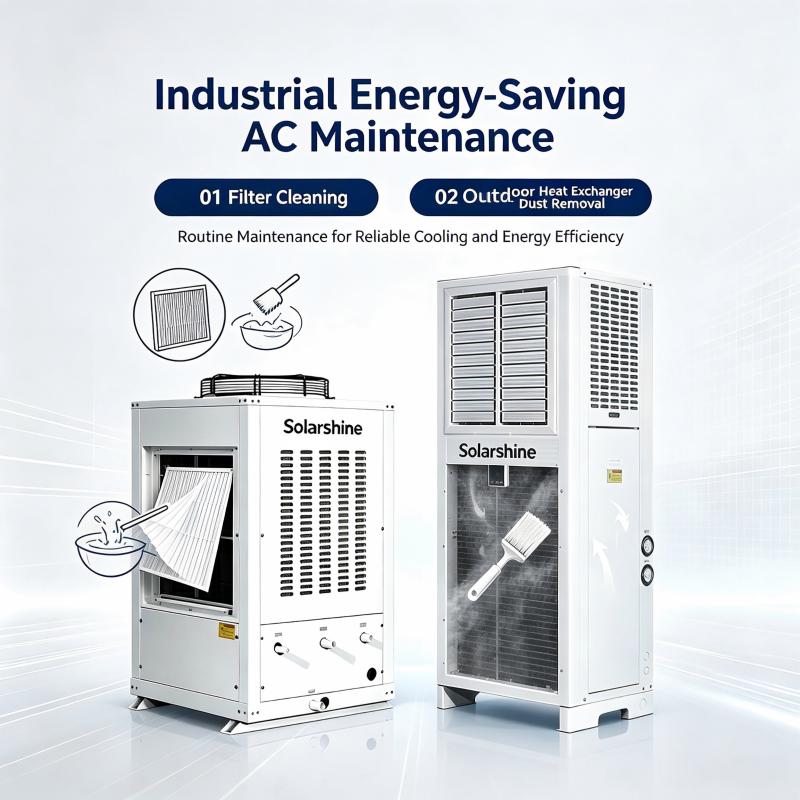
Weekend or Scheduled Shutdown: Ideal Window for Preventive Maintenance
1. Filter Cleaning
Air filters capture large volumes of dust over time. Without regular cleaning, airflow ducts become blocked and heat exchange efficiency drops sharply. Remove and wash filters periodically; ensure they are fully dried before reinstallation. This maintains unobstructed intake airflow and allows the unit to dissipate heat efficiently.
2. Outdoor Unit Heat Exchanger Dust Removal
Outdoor units are exposed outdoors and prone to buildup of dust, fibres and oily contaminants. Clogged cooling fins raise condensing temperatures, forcing compressors to draw more power while cooling output declines. Simple surface cleaning of dust restores the unit’s heat dissipation efficiency.
3. Visual Unit Inspection
Check for dirt accumulation on the unit casing, loose air duct connections and normal drainage flow. Address minor issues early to prevent small defects from escalating into costly major failures.
Electrical System Safety Inspection (Priority Item)
SolarShine Industrial Energy Saving Air Conditioner
Electrical safety forms the foundation of reliable industrial equipment operation. Always isolate power during weekly shutdowns. Inspect wiring terminals for looseness, ageing and oxidation. Keep electrical control enclosures sealed and dry to block dust and moisture, which can cause short circuits, unexpected tripping and unplanned shutdowns.
Reinforce moisture protection for control systems in high‑temperature, rainy, coastal and humid overseas plant locations to avoid unstable operation caused by moisture ingress.
Important notice: Always disconnect power before carrying out any electrical inspections. Untrained personnel must not disassemble or service the main control board.
Pre‑Production Trial Run Check
Carry out a 5–10 minute no‑load trial run prior to restarting operations every Monday:
- Verify normal operating noise levels
- Confirm consistent airflow volume and cooling response
- Watch for unusual vibration or active alarm codes
Running a pre‑shift test helps avoid unexpected unit failures during production hours and supports uninterrupted workshop operation throughout the working day.
Post time: Sep-10-2026