
Direct PV-driven heat pumps have emerged as a hot topic across the global renewable energy industry. Many manufacturers have rolled out new direct PV air-source and ground-source heat pump products, fuelled by favourable policy incentives. Even so, most northern heating projects run into practical barriers: limited rooftop area, seasonal misalignment between solar irradiance and heating demand, high upfront capital cost, plus complicated multi-unit integration and operation and maintenance (O&M). These issues greatly erode the cost-effectiveness of residential winter heating projects.
With the residential winter heating segment facing fierce competition and poor economic returns, the industry has begun to identify domestic hot water (DHW) and high-temperature cooling projects in the Middle East as the most promising application areas. These two use cases avoid nearly all drawbacks seen in conventional heating applications.
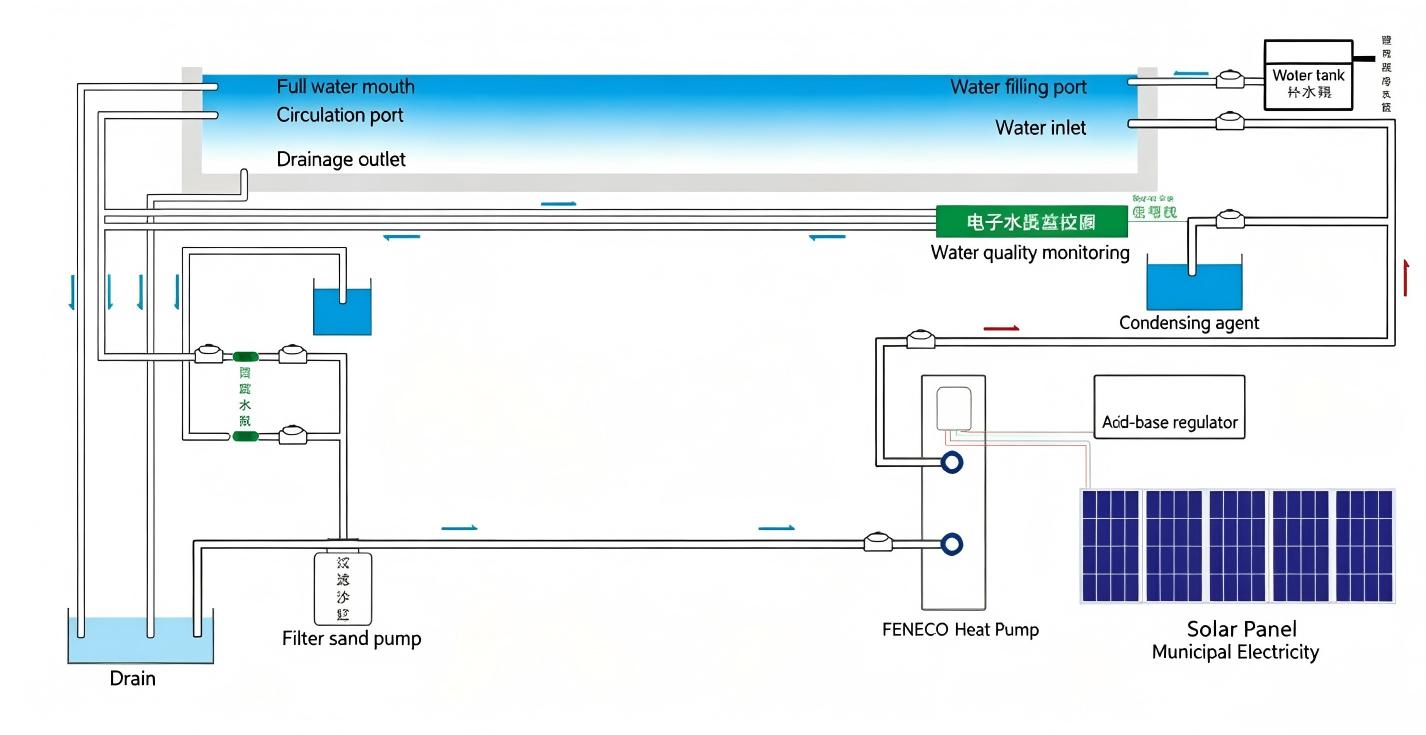
I. Direct PV + Domestic Hot Water: Steady Year-Round Load Eliminates Seasonal Supply-Demand Imbalance
As noted above, the main flaw of northern heating projects is supply-demand imbalance. Solar irradiance is lowest in heating seasons, while midday PV output peaks fail to align with morning and evening heating loads. Centralised DHW systems are free from this conflict.
Year-Round Stable Load, Maximizing PV Utilization
Hotels, dormitories, public bathhouses, industrial park dormitories, and commercial buildings have uninterrupted hot water demands year-round, with relatively balanced water consumption across four seasons. PV power can be fully utilized 365 days a year, eliminating the problem of idle equipment in summer and insufficient power generation in winter. During daytime, on-site self-consumed PV power directly drives heat pumps to produce hot water. Excess electricity is converted into thermal energy and stored in water tanks. This energy storage method removes the need for costly lithium batteries. Relying only on hot water tanks for load shifting drastically cuts storage expenses and bypasses the high cost of electrochemical energy storage.
Simplified Operation Mode, Significantly Reduced System Complexity
DHW systems run solely on heating mode, unlike combined heating and cooling systems, so the overall configuration can be greatly streamlined. DC direct PV heat pumps eliminate grid-tied inverters. PV direct current feeds compressors directly and reduces energy loss caused by two-stage AC-DC power conversion. The whole system only consists of PV panels, direct-drive heat pumps and hot water storage tanks. Fewer pieces of equipment and fewer suppliers prevent disputes between different vendors, substantially lowering maintenance difficulty.
Superior Economics Compared to Heating Projects, Controllable Payback Period
Hot water projects avoid cutthroat price competition with evacuated tube solar thermal systems. Solar thermal equipment often suffers from overheating, tube rupture and scaling in summer, and auxiliary electric heating is always required. In contrast, PV-direct heat pumps can stably generate hot water all year round. Surplus electricity generated in summer can be fully used for hot water storage without high-temperature idling.
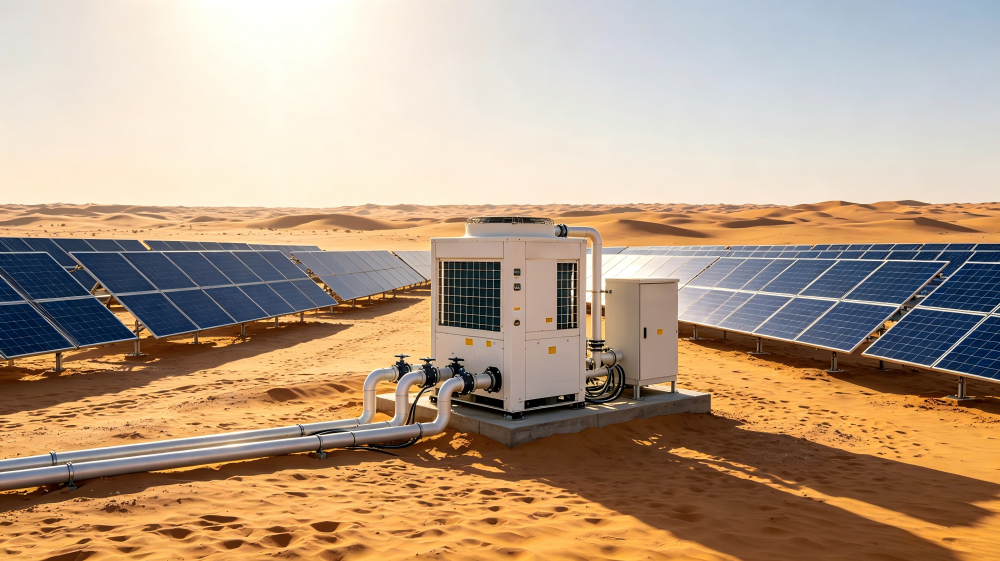
II. Direct PV Heat Pumps: Ideal Solution for High-Ambient Cooling in the Middle East
If commercial hot water projects serve as a low-risk priority market, cooling demand in the sweltering Middle East forms a new incremental growth market for PV direct-drive technology.
Perfect Resource Match: PV Generation Peak Coincides with Cooling Load Peak
The Middle East has long-lasting high temperatures all year round, and building cooling loads concentrate heavily around noon. The stronger the sunlight and the higher the ambient air temperature, the greater the cooling requirement, which perfectly overlaps with peak PV power output. The PV output curve closely matches the diurnal cooling load of buildings, requiring almost no energy storage for load buffering. On-site cooling units can fully consume locally generated solar power, achieving a self-consumption rate of over 90%. Unlike northern heating projects, where power supply and heating demand are staggered day and night, Middle Eastern cooling scenarios naturally fit PV direct-drive technology and fundamentally solve the industry-wide pain point of load-generation mismatch.
Coping with High-Temperature Operating Conditions with Outstanding Direct-Drive Performance
Daytime ambient air temperature in the Middle East often rises above 45°C. Conventional alternating-current heat pumps suffer from spiking electric current and soaring energy consumption under such high temperatures. PV-driven DC variable-speed heat pumps can adjust compressor frequency in real time according to PV output. Solar power dynamically matches cooling capacity based on sunlight intensity, with no need to draw supplementary power from the grid to balance load fluctuations. This not only cuts expensive grid capacity expansion fees for overseas industrial users but also avoids high peak electricity prices, greatly lowering long-term operating costs.
Less Dependence on Municipal Grid, Suitable for Remote Park Projects
Numerous oilfield camps, desert industrial zones and tourist resorts in the Middle East are far from urban main power grids, suffering from unstable power supply and pricey grid connection costs. A PV plus direct-drive cooling heat pump system can form a standalone microgrid system and get rid of reliance on municipal power. The whole set of equipment adopts integrated modular design, prefabricated in factories and quickly assembled on-site, which perfectly fits overseas EPC projects. In addition, the high system integration means a single manufacturer provides the complete package including main units, PV modules and control systems. It avoids cross-border after-sales conflicts among multiple brands and reduces maintenance difficulties for overseas projects, meeting the delivery requirements of international engineering contracts.
Aligned with the Middle East’s Net-Zero Carbon Development Roadmap
Countries across the Middle East are vigorously developing solar PV energy to replace fossil-fuel power and curb electricity consumption of air conditioning systems powered by oil and natural gas. PV direct-drive cooling systems run purely on solar power without fossil energy input, meeting certification standards for international green buildings and zero-carbon camps. They have become core technical selling points for export projects.
III. Comparative Summary: Cooling and DHW Projects Thrive While Heating Projects Face Limitations
表格
|
Application Scenario |
Core Contradiction |
PV-Direct Adaptability |
Core Optimization Solution |
| Single Winter Heating in the North | Seasonal mismatch between solar irradiance and heating load, limited rooftop area, high energy storage cost | Low | Prioritize solar thermal plus auxiliary heat pump |
| Year-Round DHW (Hotels, Dormitories) | Stable heat load; only hot water tanks needed for thermal storage | Extremely High | DC direct-drive configuration with hot water storage tank and simplified system |
| Middle East High-Temperature Cooling | Midday cooling load perfectly synchronized with PV power generation | Extremely High | PV direct-drive variable-speed chiller with off-grid and on-grid dual operation modes |
IV. Optimization Suggestions for On-Site Implementation
Market Positioning
Shift focus away from residential heating and target commercial & industrial DHW projects. PV direct-drive heat pumps should no longer compete with solar thermal products on cost in northern residential heating markets. Developers should prioritize commercial hot water projects. Steady year-round heat load plus low-cost water thermal storage can maximize the economic benefits of PV direct-drive systems while complying with mandatory solar installation codes for new buildings.
Product Upgrades
Develop inverter-free DC direct-drive heat pumps. Remove grid-tied inverters and design heat pump compressors driven directly by PV direct current. This reduces power conversion loss, simplifies hardware structure and lowers the upfront cost of the whole system, improving the price competitiveness of hot water units and cooling chillers.
Overseas Development
Develop high-temperature resistant direct-drive cooling units tailored for Middle Eastern climates. Optimize compressors and heat exchangers to withstand ambient temperatures above 45°C. Launch modular PV direct-drive chillers equipped with off-grid energy management systems, delivering packaged new-energy cooling solutions for desert camps and industrial parks and opening up a second overseas growth curve.
Conclusion
Returning to the original question: Can PV direct-drive heat pumps become mainstream products in the future? In the northern single winter heating market, the technology is restricted by limited rooftop area and seasonal imbalance of solar resources, making large-scale promotion difficult. However, if we step out of the heating sector and focus on year-round domestic hot water projects, as well as daytime cooling markets in tropical regions including the Middle East, all inherent drawbacks of PV direct-drive solutions will disappear. Solar resources, energy loads and operating modes achieve perfect alignment.
No technology is universally superior. Success hinges on matching products with suitable application scenarios. Direct PV-driven heat pumps will not gain widespread adoption in northern winter heating projects. Their real growth potential lies in year-round domestic hot water systems and high-temperature cooling projects across sunbelt regions such as the Middle East.
Post time: Jun-30-2026